Hiring employees across international borders involves more than selecting qualified candidates and issuing employment contracts. Employers must verify identities, authenticate professional credentials, secure the required work permits, complete government formalities, and meet country-specific immigration and labor requirements. A delay in any of these steps can affect joining dates, project schedules, workforce planning, and business operations.
Technology-assisted verification is changing how organizations manage these responsibilities. Automated document processing, identity checks, digital record management, and workflow tracking can help reduce administrative workloads and identify missing information earlier. However, technology alone cannot interpret every regulatory requirement or resolve every government-related issue.
This is where Public Relations Officer (PRO) teams play an important role. In markets such as Saudi Arabia and other Gulf countries, PRO professionals help businesses navigate government procedures, coordinate documentation, manage submissions, and follow up on administrative requirements.
At BVS Global, we support organizations with PRO and GRO services, verification, attestation and legalization, immigration, and global mobility requirements. By combining structured processes, technology-assisted administration, and practical knowledge of local procedures, we help businesses manage the complexities of cross-border workforce onboarding.
Why Cross-Border Workforce Onboarding Requires Stronger Compliance Controls
International recruitment creates compliance obligations across multiple jurisdictions. The requirements depend on the employee’s nationality, destination country, job category, sponsoring entity, and intended length of stay.
A typical onboarding process may involve identity verification, educational certificate attestation, employment document authentication, work authorization, medical examinations, residence permits, and government registrations.
The challenge is that these activities often depend on one another. An incomplete educational certificate may delay professional licensing. A discrepancy in a passport name may require correction before a visa application can proceed. An expired company registration or missing employer authorization may prevent a government submission.
Organizations therefore need a coordinated process rather than a collection of disconnected administrative tasks.
Three factors make this especially important:
- Multiple regulatory authorities: Documents may need approval from educational institutions, notaries, foreign ministries, embassies, or destination-country authorities.
- Different national requirements: A document accepted in one country may require additional authentication or translation in another.
- Time-sensitive obligations: Visa validity, work authorization, appointment availability, and joining dates can affect the onboarding schedule.
A centralized compliance process helps employers identify dependencies, assign responsibility, and maintain a clear record of each employee’s onboarding status.
How AI-Powered Verification Supports Workforce Onboarding
Technology-assisted verification can improve the speed and consistency of document handling. Its value lies in reducing repetitive work while allowing qualified personnel to focus on exceptions, regulatory interpretation, and decisions requiring human judgment.
| Technology | Application in onboarding | Compliance benefit |
| Optical character recognition (OCR) | Extracts information from passports, certificates, and application forms | Reduces manual data entry |
| Automated document checks | Flags missing fields, expired documents, or inconsistent information | Helps identify errors before submission |
| Identity verification tools | Compare submitted identity information against supported verification sources | Helps detect discrepancies and potential identity risks |
| Workflow automation | Routes documents to the appropriate reviewer or processing stage | Improves accountability and process visibility |
| Centralized document management | Organizes records, versions, approvals, and supporting evidence | Supports traceability and audit preparation |
| Status monitoring | Tracks pending documents, appointments, and application milestones | Helps teams identify delays and follow up promptly |
These tools can support the onboarding process, but their capabilities depend on the quality of the data, the systems involved, and the checks authorized for the specific use case.
For example, OCR may extract a passport number incorrectly if a document is damaged or poorly scanned. An automated system may flag a name mismatch without understanding that the difference comes from transliteration between languages. A document that appears complete may still require authentication by a designated authority.
For this reason, automated checks should support—not replace—document review, official verification, and regulatory judgment.
The Expanding Role of PRO Teams in Government Compliance
PRO teams help organizations complete government-facing administrative procedures associated with business operations and employee mobility. Their responsibilities can extend from document preparation to application coordination, government follow-ups, and record maintenance.
As organizations adopt digital onboarding systems, PRO professionals increasingly serve as the link between internal HR teams, employees, service providers, and government authorities.
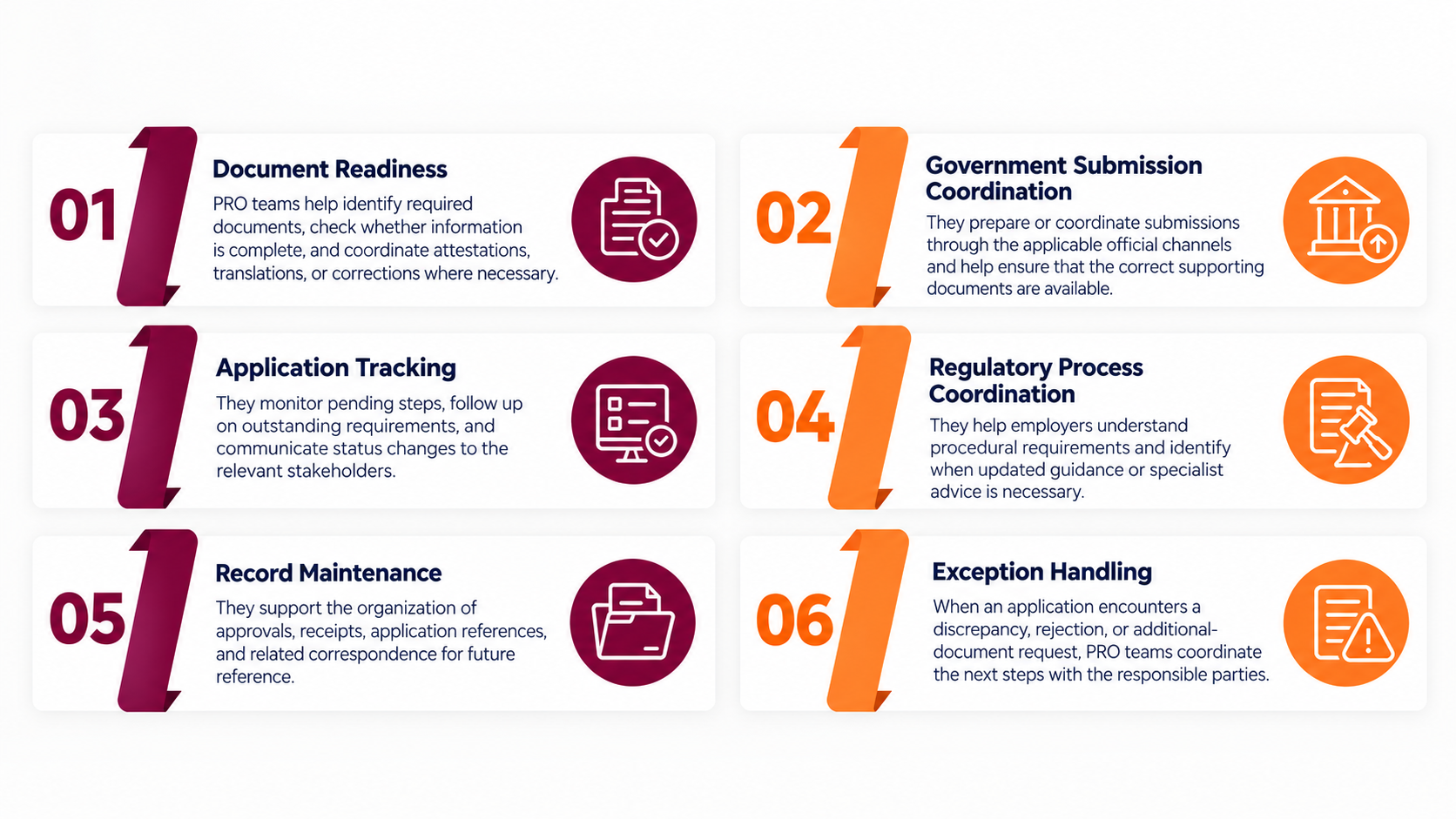
Key responsibilities of modern PRO teams
Document readiness: PRO teams help identify required documents, check whether information is complete, and coordinate attestations, translations, or corrections where necessary.
Government submission coordination: They prepare or coordinate submissions through the applicable official channels and help ensure that the correct supporting documents are available.
Application tracking: They monitor pending steps, follow up on outstanding requirements, and communicate status changes to the relevant stakeholders.
Regulatory process coordination: They help employers understand procedural requirements and identify when updated guidance or specialist advice is necessary.
Record maintenance: They support the organization of approvals, receipts, application references, and related correspondence for future reference.
Exception handling: When an application encounters a discrepancy, rejection, or additional-document request, PRO teams coordinate the next steps with the responsible parties.
In Saudi Arabia, for example, workforce administration may involve immigration and labor-related procedures, employer records, work authorization, and residence documentation. The precise process depends on the employee’s circumstances, the employer’s status, and the applicable rules.
A capable PRO team helps coordinate these moving parts without treating every application as an identical case.
Where Verification and PRO Services Work Together
Verification and government compliance are closely connected, but they serve different purposes.
Verification establishes whether relevant identity details, qualifications, employment history, or other claims can be supported by appropriate evidence. PRO services help coordinate the administrative and government-facing steps required to progress a case.
Their combined value becomes clearer when examined across the onboarding lifecycle.
| Onboarding stage | Verification requirement | PRO team contribution |
| Candidate selection | Review identity and relevant credentials | Identify documentation needed for the intended role and destination |
| Pre-departure preparation | Check certificates and supporting records | Coordinate attestation, legalization, translation, or correction requirements |
| Work authorization | Confirm that application details are supported by the available documents | Coordinate submission requirements and follow-up |
| Arrival and registration | Confirm the availability and validity of required records | Coordinate applicable post-arrival formalities |
| Ongoing employment | Monitor documents with expiry dates or renewal requirements | Help organize renewals and required administrative actions |
| Audit preparation | Maintain evidence supporting completed checks | Compile relevant records and submission history |
This coordination can prevent avoidable rework. When verification identifies an inconsistency before an application is submitted, the employer has a better opportunity to correct it before the issue affects the employee’s joining date.
However, document verification does not itself grant a visa, work permit, or residence authorization. Only the competent authority can make the relevant official decision.
The Business Case for Digital Verification and Compliance Management
The value of technology-assisted onboarding should be measured through operational results rather than claims of automation alone.
Organizations can assess performance by tracking the time required to prepare applications, the proportion of submissions returned for correction, the number of outstanding documents, and the time needed to resolve exceptions.
Consider the following illustrative measurement framework.
| Performance indicator | What it measures | Why it matters |
| Document completeness rate | Percentage of cases ready for submission without missing required records | Indicates preparation quality |
| First-pass acceptance rate | Percentage of submissions accepted without correction or resubmission | Helps assess process effectiveness |
| Average processing time | Time from document collection to the relevant process milestone | Supports workforce planning |
| Exception resolution time | Time required to resolve discrepancies or additional requests | Highlights coordination bottlenecks |
| Renewal completion rate | Percentage of applicable renewals completed by the required deadline | Helps manage ongoing compliance |
| Cost per completed case | Total relevant processing cost divided by completed cases | Supports budgeting and process improvement |
These indicators should be measured against a documented baseline. Processing time must also be separated into internal handling time and time spent waiting for government decisions, appointments, or third-party responses.
That distinction matters because a company can improve its own document preparation without controlling the time an authority takes to issue a permit.
A practical example
Suppose an employer is onboarding 100 employees for a project in another country. If each case requires repeated manual checks, separate email follow-ups, and independent document tracking, the HR and PRO teams may spend substantial time locating records and resolving preventable errors.
A centralized workflow can assign each employee a case reference, record required documents, flag missing information, and direct unresolved issues to the responsible reviewer.
The employer can then compare the time spent on administration, the number of resubmissions, and the rate of on-time onboarding before and after implementation. The actual savings will depend on case complexity, existing processes, technology costs, and the level of automation achieved.
This approach provides a defensible basis for investment decisions without relying on unsupported productivity claims.
Government Compliance in Saudi Arabia and Other International Markets
Cross-border workforce onboarding requires country-specific procedures. Employers cannot assume that a workflow suitable for one destination will meet the requirements of another.
Saudi Arabia illustrates why local process knowledge matters. Depending on the case, an employer may need to coordinate work authorization, visa-related formalities, residence documentation, employee records, and other applicable government requirements. Relevant procedures may involve official government platforms and the employer’s authorized representatives.
Organizations operating across multiple markets should pay particular attention to the following areas:
- Document authentication: Determine whether a certificate requires attestation, legalization, translation, or another form of acceptance for its intended use.
- Employer eligibility: Check the employer’s applicable registrations, permissions, and status before initiating dependent applications.
- Employee eligibility: Confirm that the proposed role and individual circumstances meet the relevant requirements.
- Renewal planning: Track applicable expiry dates and begin required processes early enough to address foreseeable issues.
- Regulatory changes: Review current official guidance rather than relying exclusively on historical checklists.
- Local coordination: Assign responsibility for communication with authorities, employees, and other parties involved in processing.
A regional or global employer may also need to manage different procedures for the same employee journey. A certificate issued in one country may require authentication in its country of origin before it can be used in the destination country.
Our approach at BVS Global brings together relevant service areas—including verification, attestation and legalization, PRO and GRO services, immigration and citizenship, and global mobility—to help organizations coordinate these requirements across international markets.
Data Protection and Responsible Use of Automation
Verification systems handle sensitive records, including passport details, educational certificates, employment information, and other personal data. Faster processing is not useful if it introduces avoidable privacy or security risks.
Employers and service providers should establish clear controls around data collection, access, storage, retention, and transfer.
Important safeguards include:
- Data minimization: Collect only the information needed for the specific verification or compliance purpose.
- Role-based access: Restrict access to authorized employees and service providers.
- Secure document handling: Use appropriate safeguards for document transmission, storage, and sharing.
- Human review: Require qualified review when a system flags discrepancies, produces uncertain results, or supports a consequential decision.
- Audit trails: Maintain appropriate records of submissions, approvals, corrections, and access.
- Retention controls: Apply relevant legal and contractual requirements when deciding how long records should be kept.
- Vendor oversight: Assess the security, privacy, and data-handling practices of external technology providers.
Organizations should also evaluate applicable data protection laws in the countries where employees are recruited, where information is processed, and where records are stored. Cross-border transfers may trigger additional obligations.
Automated outputs should not be treated as conclusive evidence of fraud or noncompliance. A discrepancy may arise from a spelling variation, translation, document format, or legitimate change in personal information. The appropriate response is to investigate the evidence and resolve the issue through a documented process.
How Businesses Can Build a More Effective Onboarding Framework
Organizations do not need to automate every step at once. A phased approach allows them to improve high-volume activities while retaining appropriate controls for complex cases.
Step 1: Map the onboarding process. Document each required activity, responsible party, dependency, and approval point for the relevant destination country.
Step 2: Standardize document requirements. Develop country- and employee-specific checklists, with clear instructions for document quality, authentication, and submission.
Step 3: Digitize routine administration. Introduce suitable tools for document collection, data extraction, case tracking, reminders, and record management.
Step 4: Establish escalation rules. Define which cases can proceed through routine checks and which require specialist review or direct confirmation from an official source.
Step 5: Integrate HR and PRO workflows. Give relevant teams a shared view of case status, outstanding documents, deadlines, and next actions, subject to appropriate access controls.
Step 6: Measure and improve performance. Review processing times, rejection reasons, recurring errors, and compliance deadlines to identify practical improvements.
Step 7: Review changes regularly. Update procedures when official requirements, government platforms, or internal policies change.
A strong framework combines clear ownership, reliable documentation, suitable technology, and knowledgeable people. It does not depend on automation alone.
Conclusion
Cross-border workforce onboarding requires a coordinated approach to verification, documentation, government procedures, and ongoing compliance. Technology-assisted verification can reduce repetitive administration and improve visibility, while PRO teams provide the coordination and procedural expertise needed to move cases through the appropriate channels.
The most effective model combines automated checks with human review, country-specific requirements, secure record management, and clear accountability. It also recognizes that government approvals remain subject to the decisions and timelines of the relevant authorities.
At BVS Global, we support businesses through verification services, attestation and legalization, PRO and GRO services, immigration and citizenship, and global mobility solutions. Our focus is on helping organizations coordinate complex administrative requirements with a structured, professional approach.
For businesses expanding internationally or recruiting employees across borders, a well-managed onboarding process can improve operational readiness, strengthen compliance controls, and provide employees with a clearer path from recruitment to deployment.
Frequently Asked Questions
1. How can AI-powered verification help prevent work permit delays during cross-border onboarding?
AI-powered verification tools can identify missing documents, expired credentials, inconsistent personal details, and data-entry errors before an application is submitted. When integrated with HR and PRO workflows, these checks help teams resolve documentation issues earlier. However, government processing times and approval decisions remain outside the employer’s control.
2. What role do PRO teams play in Saudi Arabia’s employee onboarding and government compliance procedures?
PRO teams coordinate government-facing administrative procedures, including relevant visa formalities, work authorization documentation, residence permit processes, employer records, and application follow-ups. The exact responsibilities depend on the employee’s circumstances and applicable Saudi regulations. They also help employers identify documentation gaps and track outstanding requirements.
3. Can automated document verification replace certificate attestation and legalization for international employment?
No. Automated verification can help review document details and identify inconsistencies, but it does not replace authentication, attestation, or legalization required by the relevant authorities. Employers must establish the destination country’s specific requirements and complete the applicable formalities before using documents for employment or immigration purposes.
4. Which compliance metrics should employers track when evaluating digital verification and PRO services?
Employers should monitor document completeness rates, first-pass application acceptance rates, internal processing time, exception resolution time, renewal completion rates, and cost per completed case. Separating internal handling time from government processing time helps organizations assess service performance accurately and identify where improvements are possible.
5. How can BVS Global support companies managing verification and government compliance across multiple countries?
At BVS Global, we support businesses with verification services, attestation and legalization, PRO and GRO services, immigration and citizenship, and global mobility solutions. Our services help organizations coordinate document preparation, government-facing procedures, and related administrative requirements across international markets, with processes aligned to the applicable country-specific requirements.