Expanding into Saudi Arabia can create significant opportunities for foreign companies, but entering the market requires more than registering a company and opening an office. Foreign investors must align their proposed activities with Saudi investment rules, complete the appropriate investment registration, establish the legal entity, obtain commercial and sector-specific approvals, manage tax and employment registrations, and ensure that expatriate employees have the correct immigration and work authorisations.
For foreign companies, the Saudi expansion process should be approached as one connected compliance programme covering company formation, immigration, taxation, employment and operational licensing. The exact requirements depend on the business activity, ownership structure, legal form, location and whether the company is establishing a subsidiary, branch, regional headquarters or another permitted structure.
Saudi Arabia’s investment framework has also evolved significantly. Under the updated Investment Law, a foreign investor must register with the Ministry of Investment of Saudi Arabia (MISA) before engaging in investment activities. Once registration is completed, the investor can proceed with the Commercial Registration and other licences required by the relevant authorities.
This checklist explains the major steps foreign businesses should consider when planning an expansion into the Kingdom.
Confirm Whether Your Business Activity Is Open to Foreign Investment
The first step is not incorporation. It is determining whether the proposed activity is available to foreign investors and whether it carries additional conditions.
MISA’s current investment framework provides for foreign investment in approved economic activities, while certain activities may be restricted or excluded. The requirements can also differ according to the activity category. MISA’s 2026 Investor Guide states that investment registration is available for approved economic activities according to the requirements applicable to the relevant activity category.
Before committing capital, a foreign company should therefore check:
- The exact ISIC activity classification.
- Whether the activity is open to foreign investment.
- Whether additional approvals are required.
- Whether minimum capital or ownership conditions apply.
- Whether a professional, financial, industrial or sector-specific licence is required.
- Whether the proposed activities can be included within the intended Commercial Registration.
This early assessment can prevent a common expansion problem: establishing an entity first and discovering later that the intended operational activity requires a different licence or additional approval.
Choose the Right Saudi Legal Structure
A foreign company needs to select a structure that matches its commercial objectives.
Depending on the circumstances, a foreign business may consider a Saudi subsidiary, branch or regional headquarters structure. Saudi company law specifically recognises foreign companies operating through branches, representative offices or other permitted forms under the applicable investment and statutory framework.
An important consideration is whether the Saudi entity will operate as a standalone local business or as an extension of an overseas company.
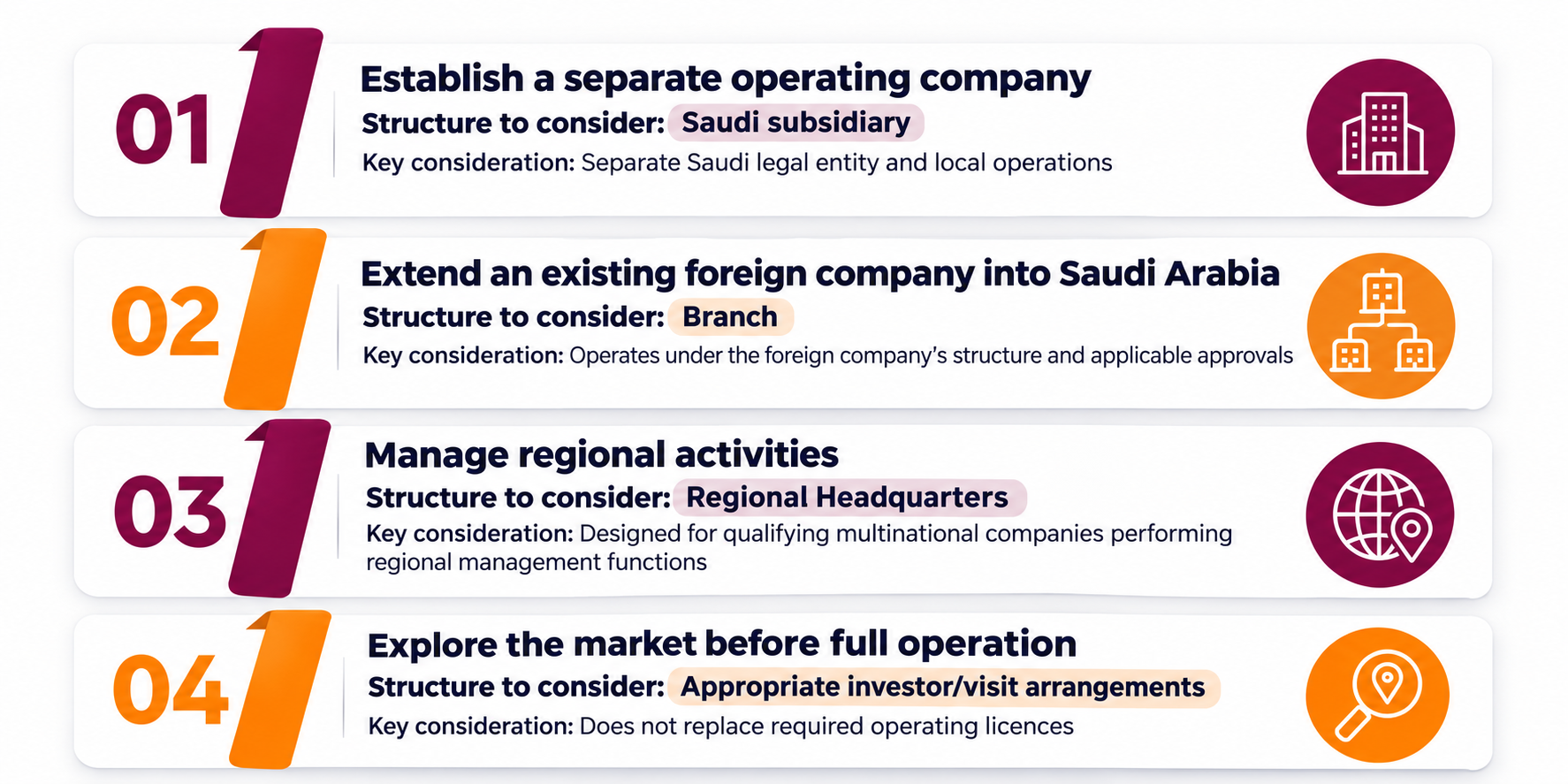
| Expansion requirement | Structure to consider | Key consideration |
| Establish a separate operating company | Saudi subsidiary | Separate Saudi legal entity and local operations |
| Extend an existing foreign company into Saudi Arabia | Branch | Operates under the foreign company’s structure and applicable approvals |
| Manage regional activities | Regional Headquarters | Designed for qualifying multinational companies performing regional management functions |
| Explore the market before full operation | Appropriate investor/visit arrangements | Does not replace required operating licences |
The appropriate structure should be determined before submitting applications because the documentation, approvals and ongoing compliance obligations can differ.
Complete MISA Investment Registration
For foreign investors, MISA registration is a central stage of market entry.
The updated Investment Law requires a foreign investor to register with MISA before carrying out investment activities. After receiving notification that registration has been completed, the investor can proceed with the Commercial Registration and obtain the necessary licences from other competent authorities.
MISA’s 2026 Investor Guide currently indicates an estimated processing time of 10 working days for investment registration, subject to the application being complete and satisfying the applicable requirements. The guide also identifies documentation such as the foreign company’s Commercial Register and financial statements, with authentication requirements depending on the applicant.
Companies should therefore prepare a document pack covering:
- Foreign parent-company registration documents.
- Audited or required financial statements.
- Constitutional documents.
- Shareholder and ownership information.
- Proposed Saudi activities.
- Authorisations and powers of attorney.
- Documents requiring legalisation or authentication.
- Activity-specific supporting documents.
Requirements can change according to the investment category, so the latest MISA service requirements should be checked before submission.
Establish the Saudi Company and Obtain the Commercial Registration
Once the investment registration stage has been completed, the company formation process can proceed through the Saudi Business Center and Ministry of Commerce.
The Ministry of Commerce provides an electronic service for establishing a company under an investment registration/licensing framework. The service allows applicants to enter partner, company, management and Commercial Registration information through the Saudi Business Center. The Ministry currently lists a service duration of up to 72 hours for this service when requirements are satisfied.
The Saudi Companies Law also supports simplified incorporation procedures and includes the Simplified Joint Stock Company as a legal form.
For foreign businesses, Saudi Arabia company formation services can be particularly useful where the expansion involves multiple government platforms, authenticated documents, shareholder resolutions and activity-specific approvals.
Secure the Business Address and Local Operating Approvals
Company registration does not automatically mean that a business can begin every operational activity.
Depending on the business, additional municipal, commercial, professional, industrial, environmental, tourism, healthcare, financial or other approvals may be necessary.
For businesses requiring a municipal commercial licence, the Balady platform provides electronic commercial licensing services. Requirements can include information concerning the activity and premises, lease or ownership documentation, building permits and safety-related documentation depending on the activity.
Foreign companies should therefore create an activity-to-licence matrix before opening operations.
For example:
| Area | Typical authority/platform | What to verify |
| Investment registration | MISA | Foreign investment eligibility |
| Company formation | Saudi Business Center / Ministry of Commerce | Legal structure and CR |
| Municipal operations | Balady / relevant municipality | Premises and commercial activity |
| Tax | ZATCA | Tax registration and filing obligations |
| Employment | MHRSD / Qiwa | Labour and workforce compliance |
| Social insurance | GOSI | Employee registration |
| Immigration | Relevant government systems | Visas and residence status |
| Sector regulation | Relevant regulator | Activity-specific licence or approval |
The exact authority will depend on the business activity.
Build a Saudi GRO Advisory Plan
Government Relations Officer, or GRO, support becomes especially important when a company has to coordinate multiple government-facing processes.
A GRO function can help businesses manage government documentation, application submissions, renewals, approvals, employee-related government procedures and communication with relevant authorities.
However, GRO advisory should not be viewed simply as paperwork processing. For a foreign company, it should form part of the broader compliance system.
A strong GRO checklist should cover:
- Government account setup.
- Commercial Registration administration.
- Licence applications and renewals.
- Government correspondence.
- Employee documentation.
- Visa and work-permit coordination.
- Government portal administration.
- Regulatory deadlines.
- Document authentication.
- Company amendments.
- Branch or subsidiary compliance.
- Activity-specific approvals.
Professional PRO services Saudi Arabia can complement this function by helping companies coordinate employee visas, work permits, residence documentation and other government-facing requirements.
Register for Tax and ZATCA Requirements
Tax registration should be incorporated into the expansion plan rather than treated as an afterthought.
Saudi Arabia’s Zakat, Tax and Customs Authority (ZATCA) administers several important tax obligations. ZATCA states that income tax provisions apply to resident capital companies with respect to shares owned by non-Saudi partners, as well as to non-resident persons conducting business in Saudi Arabia through a permanent establishment or deriving Saudi-source income.
Foreign companies should assess:
- Corporate income tax exposure.
- Zakat treatment where applicable.
- VAT registration.
- Withholding tax.
- Customs obligations.
- Transfer pricing requirements where relevant.
- E-invoicing.
- Tax return and payment deadlines.
VAT registration is mandatory once the relevant taxable annual revenue threshold is exceeded. ZATCA currently identifies SAR 375,000 as the mandatory registration threshold and SAR 187,500 as the threshold above which voluntary registration is available for the relevant taxpayer category.
E-invoicing also remains an important compliance requirement. ZATCA’s Phase Two integration programme continues to roll out in waves. In July 2026, ZATCA announced Wave 25, covering taxpayers whose VAT-subject revenues exceeded SAR 187,500 in relevant years, with affected taxpayers to integrate with the Fatoora platform by 1 February 2027.
Set Up Employment and Workforce Compliance
Hiring employees introduces another layer of regulatory requirements.
Companies employing expatriates need to manage work permits, visas, residence documentation and employment-related compliance through the applicable government systems.
MHRSD’s Qiwa platform supports work-related government services, including visa applications and work permits. The Ministry’s current visa service allows eligible establishments to request permanent and temporary work visas electronically through Qiwa.
Work permits are also linked to residence status. MHRSD states that employers must issue a work permit for an expatriate employee within the applicable period following entry, and the permit is one of the requirements associated with issuing or renewing regular residency.
Foreign companies should establish a workforce compliance checklist covering:
- Employment contract.
- Qiwa registration and employment documentation.
- Work visa.
- Work permit.
- Residence documentation.
- Medical and other applicable requirements.
- Employee registration.
- Payroll compliance.
- Wage Protection requirements.
- Contract renewal and expiry monitoring.
Plan for Saudization and Workforce Localisation
Saudization should be considered before the first employee is recruited.
The applicable localisation requirements can vary according to the company’s activity, workforce size and regulatory classification. MHRSD provides a Nitaqat calculator through Qiwa that allows employers to assess their establishment’s position based on factors including economic activity and the number of Saudi and non-Saudi employees.
There have also been significant recent developments in workforce regulation.
Since July 2025, Saudi Arabia has implemented the classification of work permits according to skill categories. The first phase applied to workers already employed in the Kingdom, while the second phase covered incoming workers. The classification is automated through Qiwa and considers factors such as occupation and wage.
Employment contract compliance has also received greater attention. MHRSD announced updated requirements in 2026 for documenting employment contracts through Qiwa, with compliance targets increasing to 85% from 30 April 2026 and 90% by the end of June 2026.
For an expanding foreign company, workforce planning should therefore be integrated into the business plan from the beginning.
Prepare the Immigration and Visa Checklist
Immigration planning should begin before employees relocate.
The appropriate visa route depends on the individual’s role, purpose of travel, employment relationship and the company’s eligibility. Foreign companies should distinguish between:
- Investor visits.
- Business visits.
- Employment visas.
- Work permits.
- Residence documentation.
- Dependent/family arrangements.
- Temporary work arrangements.
- Other specialised immigration categories.
MISA also provides an online business visa service for foreign investors visiting Saudi Arabia to explore investment opportunities.
For employees, companies should coordinate the visa, work authorisation and residence process rather than assuming that a business visit visa permits employment.
This is one area where experienced government-relations and immigration support can significantly reduce administrative errors.
Check Sector-Specific Government Approvals
One of the biggest mistakes in international expansion is assuming that a Commercial Registration is the final approval.
It is not.
Depending on the activity, a company may require additional regulatory approvals before it can legally operate.
Potential areas include:
- Financial services.
- Healthcare.
- Education.
- Construction.
- Engineering.
- Food and hospitality.
- Tourism.
- Industrial manufacturing.
- Telecommunications.
- Energy.
- Professional services.
- Transport and logistics.
- Technology and regulated digital activities.
The Ministry of Commerce itself notes that activities requiring a prior licence must obtain the relevant licensing authority’s approval.
Therefore, foreign companies should identify every regulator associated with the proposed activity before signing leases, hiring staff or launching commercially.
Consider a Regional Headquarters Strategy
For multinational companies, Saudi Arabia may represent more than another country operation.
The Regional Headquarters (RHQ) programme is designed for qualifying multinational companies seeking to establish a regional headquarters in the Kingdom to support, manage and strategically direct branches and subsidiaries in the Middle East and North Africa region.
The programme continues to attract international companies. In August 2026, MISA reported that more than 750 companies had joined the RHQ programme, exceeding its original target of 500 companies by 2030.
A multinational company considering Saudi Arabia should therefore assess whether a standard operating entity or an RHQ model better supports its regional strategy.
Create an Ongoing Compliance Calendar
Company formation is only the beginning.
Once operations start, the business needs a compliance calendar covering:
- Commercial Registration updates and renewals.
- Business licence renewals.
- MISA requirements.
- Tax filings and payments.
- VAT obligations.
- E-invoicing requirements.
- Employee contracts.
- Work permits.
- Residence documentation.
- Saudization/localisation requirements.
- Government portal updates.
- Social insurance.
- Corporate documents.
- Sector-specific permits.
- Annual financial and regulatory obligations.
This is where a dedicated GRO or corporate compliance function becomes valuable. Instead of reacting to an expired licence or missing approval, the company can manage government obligations proactively.
Saudi Arabia Business Expansion Checklist
Before launching operations, foreign companies should be able to answer yes to the following:
| Checklist | Status to confirm |
| Proposed activity is open to foreign investment | To Confirm |
| Correct legal structure selected | To Confirm |
| MISA investment registration completed | To Confirm |
| Foreign corporate documents properly authenticated | To Confirm |
| Saudi company/branch established | To Confirm |
| Commercial Registration issued | To Confirm |
| Business address arranged | To Confirm |
| Municipal and activity-specific licences obtained | To Confirm |
| ZATCA registration assessed/completed | To Confirm |
| VAT obligations assessed | To Confirm |
| E-invoicing requirements assessed | To Confirm |
| Qiwa and employment systems established | To Confirm |
| Work permits and employee visas arranged | To Confirm |
| Residence documentation arranged | To Confirm |
| Saudization requirements assessed | To Confirm |
| GOSI and payroll obligations addressed | To Confirm |
| Sector-specific government approvals obtained | To Confirm |
| GRO/PRO responsibilities assigned | To Confirm |
| Renewal and compliance calendar established | To Confirm |
How BVS Global Supports Saudi Arabia Expansion
BVS Global helps businesses manage the practical government-facing requirements involved in entering and operating across international markets. For companies expanding into Saudi Arabia, our support can cover GRO advisory, PRO services, company formation coordination, employment and workforce documentation, visa and immigration support, government approvals and ongoing administrative requirements. Our approach is designed to give businesses a single point of support across interconnected government processes, helping them manage documentation, submissions, renewals and regulatory interactions more efficiently. Rather than treating each requirement as a separate transaction, we work around the company’s wider expansion needs so that corporate, employee and government-related processes can be coordinated more effectively.
Conclusion
Saudi Arabia offers substantial opportunities for international companies, but successful expansion depends on getting the regulatory sequence right.
The modern market-entry process starts with determining whether the proposed activity is open to foreign investment, followed by MISA registration, company formation, Commercial Registration, licensing and tax registration. The next layer involves employment, immigration, work permits, localisation requirements and ongoing government compliance.
For foreign companies, business setup Saudi Arabia for foreign companies should therefore be treated as a complete market-entry project rather than a simple incorporation exercise.
The most effective approach is to build the compliance framework before operations begin, identify every government approval required for the specific activity, prepare immigration and workforce requirements in advance, and maintain an ongoing calendar for renewals and regulatory obligations.
With the right company structure, accurate documentation, informed GRO advisory and disciplined compliance management, foreign businesses can enter Saudi Arabia with greater clarity and build a stronger foundation for long-term growth.
Frequently Asked Questions
- What are the main steps for a foreign company to expand into Saudi Arabia?
The process generally includes MISA registration, company formation, Commercial Registration, business licensing, tax registration, employment setup and immigration approvals. - What do PRO and GRO services cover in Saudi Arabia?
They help manage government documentation, visa processing, work permits, licence renewals, employee procedures and government-related submissions. - Is MISA registration required for foreign companies in Saudi Arabia?
Yes. Foreign investors generally need to complete the applicable MISA investment registration before conducting investment activities in Saudi Arabia. - What immigration requirements apply to foreign employees?
Employees generally need the appropriate employment visa, work authorisation and residence documentation, along with applicable employment and localisation requirements. - How can foreign companies simplify business setup in Saudi Arabia?
Professional Saudi Arabia company formation services and GRO/PRO support can help coordinate registration, licensing, government approvals, immigration and ongoing compliance.