For foreign companies operating in Saudi Arabia, workforce localization is no longer a human resources initiative. In 2026, Saudiization has evolved into a strategic business consideration that affects hiring, expansion planning, visa eligibility, workforce mobility, regulatory compliance, government relations, and long-term market access.
Many multinational organizations entered the Saudi market during earlier phases of the Nitaqat program with a relatively straightforward compliance approach. The objective was often to achieve the minimum Saudization percentage required for a favorable classification while maintaining operational flexibility through expatriate talent. That approach is becoming increasingly difficult to sustain.
Saudi Arabia’s latest labor market reforms are fundamentally changing how workforce localization is measured, enforced, and integrated into business operations. Authorities are moving beyond broad workforce percentages and placing greater emphasis on profession-specific localization, digital compliance systems, employment documentation standards, and sector-focused workforce development.
For foreign investors, regional headquarters, multinational corporations, and international service providers, understanding these developments has become essential for maintaining operational continuity within one of the Middle East’s most important economic markets.
Saudization Is Now Central to Saudi Arabia’s Economic Strategy
To understand the significance of current reforms, it is important to recognize that Saudiization is not an isolated labor policy.
The Kingdom’s workforce localization agenda sits at the center of Vision 2030, the national transformation framework designed to diversify the economy, reduce reliance on oil revenues, increase private-sector participation, and create sustainable employment opportunities for Saudi nationals.
Over the past decade, Saudi Arabia has invested heavily in sectors such as technology, logistics, tourism, healthcare, renewable energy, advanced manufacturing, financial services, entertainment, and infrastructure development. These industries are expected to generate substantial employment opportunities for Saudi citizens.
As a result, regulators increasingly view workforce localization as a critical mechanism for ensuring that economic growth translates into domestic employment creation.
For foreign companies, this means Saudiization regulations are becoming increasingly interconnected with broader investment objectives. Compliance is no longer assessed solely through labor inspections or workforce reporting. Localization performance increasingly influences how regulators evaluate an organization’s contribution to national economic priorities.
This shift explains why workforce localization has become a recurring consideration across multiple government initiatives, including foreign investment programs, labor market reforms, economic diversification projects, and regional headquarters incentives.
Why the 2026 Nitaqat Phase Represents a Major Shift
The newest phase of the Nitaqat program represents one of the most ambitious workforce localization initiatives introduced since the program’s modernization.
Saudi authorities have announced a three-year localization strategy extending through 2028 with the objective of creating hundreds of thousands of additional employment opportunities for Saudi nationals across the private sector.
What makes this phase particularly significant is that regulators are no longer relying exclusively on organization-wide Saudization percentages.
Instead, authorities are increasingly focusing on the actual composition of a company’s workforce.
Historically, some employers achieved compliance by concentrating Saudi hires in administrative, support, or lower-level positions while maintaining heavy expatriate representation across technical, managerial, commercial, or specialist functions.
The current regulatory direction seeks to address that imbalance.
Today, policymakers are increasingly interested in where Saudi employees work within an organization, how they progress through leadership pipelines, and whether workforce localization is occurring within strategically important professions.
For multinational organizations, this changes workforce planning assumptions that may have remained unchanged for years.
Companies that previously maintained comfortable compliance positions may find that historical hiring structures no longer align with emerging localization expectations.
The Growing Importance of Profession-Specific Localization
One of the most consequential developments for foreign employers is the expansion of profession-based Saudization requirements.
Rather than evaluating only total workforce percentages, regulators are increasingly targeting specific occupations and business functions.
This approach is particularly visible in sectors considered strategically important to economic development and knowledge transfer.
Marketing and sales functions have seen substantial localization requirements introduced across the private sector.
Procurement departments are now subject to some of the highest workforce localization expectations, reflecting the strategic role procurement professionals play within supply chains, vendor relationships, and national economic participation.
Engineering professions continue to face increasing localization obligations as Saudi Arabia accelerates industrial development, infrastructure investment, and large-scale construction projects.
Accounting, finance, and compliance functions have also become important areas of regulatory focus.
For foreign companies, this represents a structural shift in hiring strategy.
Organizations can no longer rely solely on overall workforce percentages to satisfy compliance objectives.
Instead, workforce localization must be integrated into departmental planning, succession strategies, recruitment pipelines, leadership development initiatives, and organizational design.
This trend is expected to continue as Saudi Arabia seeks greater participation of Saudi nationals within skilled, technical, and leadership-oriented occupations.
Saudization Is Becoming an Operational Risk Issue
Many organizations continue to view Saudiization as a compliance obligation managed primarily by HR departments.
In reality, workforce localization increasingly affects operational performance across multiple business functions.
A decline in compliance standing can create challenges that extend well beyond recruitment activities.
Foreign companies may encounter restrictions affecting work permit issuance, labor mobility procedures, visa approvals, and workforce expansion plans.
These challenges can have significant consequences for businesses operating within sectors that rely heavily on specialized expatriate talent.
Project-based industries are particularly vulnerable.
Engineering firms, infrastructure contractors, technology providers, healthcare operators, logistics organizations, and industrial manufacturers frequently depend on the ability to mobilize talent quickly.
Any disruption affecting workforce approvals can directly influence project delivery timelines, client commitments, operational capacity, and revenue generation.
Consequently, Saudiization compliance is increasingly being reviewed at executive and board levels rather than remaining solely within HR departments.
Organizations that view workforce localization as a business continuity issue are generally better positioned to adapt to evolving regulatory requirements.
Qiwa Has Changed the Compliance Landscape
One of the most important developments affecting workforce localization is the growing role of digital labor compliance platforms.
Among these, Qiwa has become central to labor market administration in Saudi Arabia.
For many years, organizations focused primarily on workforce counts and employment records when evaluating localization obligations.
The modern compliance environment is substantially more sophisticated.
Today, employment contracts, workforce classifications, employee records, labor documentation, and localization calculations are increasingly interconnected through digital government systems.
As authorities continue strengthening labor market oversight, properly documented employment relationships have become essential for maintaining accurate Saudization calculations.
This development creates new compliance responsibilities for employers.
An organization may believe it has achieved required localization levels, but documentation deficiencies can create discrepancies that affect regulatory assessments.
Foreign companies should therefore treat digital compliance infrastructure with the same seriousness as workforce planning.
Routine audits of employment contracts, labor records, employee classifications, compensation structures, and reporting processes have become critical components of compliance management.
The organizations most likely to encounter challenges are often not those intentionally violating regulations. Instead, difficulties frequently arise when workforce records fail to align with evolving digital compliance requirements.
Why Workforce Localization Must Be Built Into Market Entry Planning
One of the most common mistakes made by foreign investors is treating Saudiization as a post-entry compliance issue.
In reality, workforce localization should be incorporated into market entry planning from the earliest stages.
When organizations evaluate expansion opportunities within Saudi Arabia, they typically analyze taxation, licensing requirements, operating costs, real estate considerations, and commercial opportunities.
Localization obligations deserve equal attention.
Workforce localization directly influences hiring models, compensation structures, talent acquisition budgets, training investments, organizational design, and leadership succession planning.
Companies that delay localization planning often encounter higher costs later.
Recruiting Saudi talent under compressed timelines can prove more expensive and less effective than implementing a structured workforce development strategy from the outset.
Similarly, organizations that rely excessively on expatriate staffing during initial growth phases may face challenges when localization expectations increase over time.
The most successful foreign companies typically view Saudiization as a long-term workforce strategy rather than a short-term compliance exercise.
The Hidden Compliance Risks Many Foreign Companies Still Underestimate
When discussions around Saudiization arise, most organizations focus on penalties, quota percentages, or labor inspections. In practice, the most significant risks are often operational rather than financial.
A company can technically remain active while gradually losing flexibility in workforce management. This creates a situation where business growth becomes increasingly difficult despite strong commercial performance.
Consider a multinational engineering contractor awarded a major infrastructure project. Winning the contract is only the first step. The organization must then mobilize project managers, engineers, technical specialists, compliance personnel, procurement professionals, and support staff within strict timelines.
If workforce localization requirements have not been properly managed, labor approvals may become more complex. Delays in workforce deployment can affect project schedules, contractual obligations, client relationships, and ultimately profitability.
The same challenge applies to technology companies expanding operations in Riyadh, logistics firms building regional hubs, healthcare providers establishing specialist facilities, and manufacturing organizations investing in industrial capacity.
Saudiization is increasingly influencing workforce agility.
For foreign companies, the question is no longer whether localization requirements exist. The real question is whether workforce planning models are sophisticated enough to support future growth while remaining compliant.
This is why leading organizations now conduct regular workforce localization audits rather than waiting for regulatory reviews.
These audits typically evaluate:
- Workforce composition by department
- Expatriate dependency levels
- Leadership localization rates
- Profession-specific compliance exposure
- Future hiring requirements
- Internal succession planning capabilities
Organizations that identify risks early have significantly more flexibility than those reacting to compliance pressures after they emerge.
Workforce Localization Is Becoming a Talent Strategy
One of the biggest misconceptions surrounding Saudiization is the assumption that localization and business performance are competing priorities.
The reality is far more nuanced.
The most successful multinational companies operating in Saudi Arabia increasingly view workforce localization as a talent development strategy rather than a compliance obligation.
Saudi Arabia has one of the youngest populations in the Gulf region. Universities continue producing graduates across engineering, business, technology, finance, healthcare, cybersecurity, data analytics, and numerous other disciplines.
As economic diversification accelerates, competition for skilled Saudi professionals is intensifying.
Organizations that limit localization efforts to compliance targets often struggle to attract and retain top talent.
By contrast, companies that invest in professional development, leadership programs, structured career progression, and long-term workforce planning frequently achieve stronger business outcomes.
This approach delivers benefits beyond regulatory compliance.
It creates organizational stability.
It improves retention.
It strengthens institutional knowledge.
It reduces recruitment costs.
Most importantly, it establishes a sustainable workforce model aligned with Saudi Arabia’s long-term economic direction.
Building Saudi Leadership Pipelines
The next stage of workforce localization is not simply about hiring Saudi nationals.
It is about developing future leaders.
Historically, many multinational organizations localized entry-level positions while maintaining expatriate dominance across management and executive roles.
That model is becoming increasingly difficult to justify from both regulatory and business perspectives.
Companies that want long-term success in Saudi Arabia are investing heavily in leadership development programs designed to prepare Saudi professionals for managerial, strategic, and executive responsibilities.
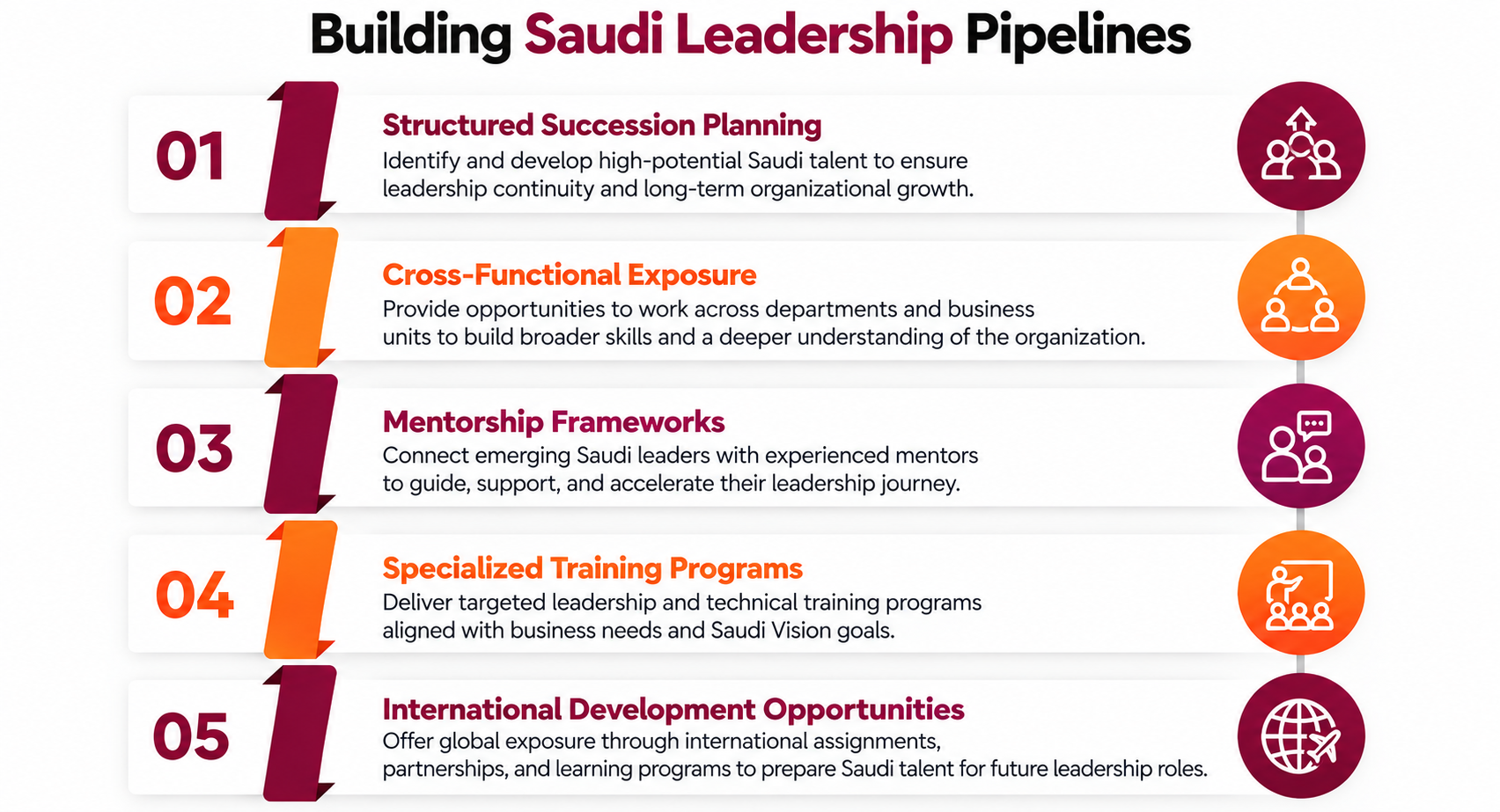
Effective programs often include:
Structured Succession Planning
Future leadership positions should be identified years before vacancies arise.
Cross-Functional Exposure
Employees gain experience across multiple business functions, improving organizational understanding and leadership readiness.
Mentorship Frameworks
Senior executives transfer knowledge, technical expertise, and commercial insight to emerging Saudi leaders.
Specialized Training Programs
Leadership development increasingly focuses on strategic thinking, financial management, operational excellence, and stakeholder engagement.
International Development Opportunities
Many multinational organizations provide exposure to global operations, strengthening leadership capabilities while supporting knowledge transfer objectives.
These investments support both workforce localization goals and long-term organizational performance.
Saudization and the Regional Headquarters Strategy
The growing importance of Saudi Arabia’s Regional Headquarters (RHQ) Program adds another layer of complexity for foreign companies.
Many multinational organizations have established regional headquarters within the Kingdom to strengthen market access, improve government engagement, and align with broader economic initiatives.
These headquarters often serve as strategic centers overseeing operations throughout the Middle East and North Africa.
As RHQ activity expands, workforce localization expectations naturally become more significant.
Regulators increasingly expect organizations benefiting from Saudi Arabia’s investment environment to contribute meaningfully to employment creation, professional development, and skills transfer.
This means localization planning should be integrated directly into regional headquarters workforce strategies.
Organizations that treat Saudiization as a separate compliance function frequently encounter challenges.
Those that align workforce localization with broader corporate strategy generally achieve stronger outcomes.
The most successful companies view Saudi talent as an essential component of regional leadership development rather than simply a regulatory requirement.
Compliance Requirements for Foreign Companies in Saudi Arabia
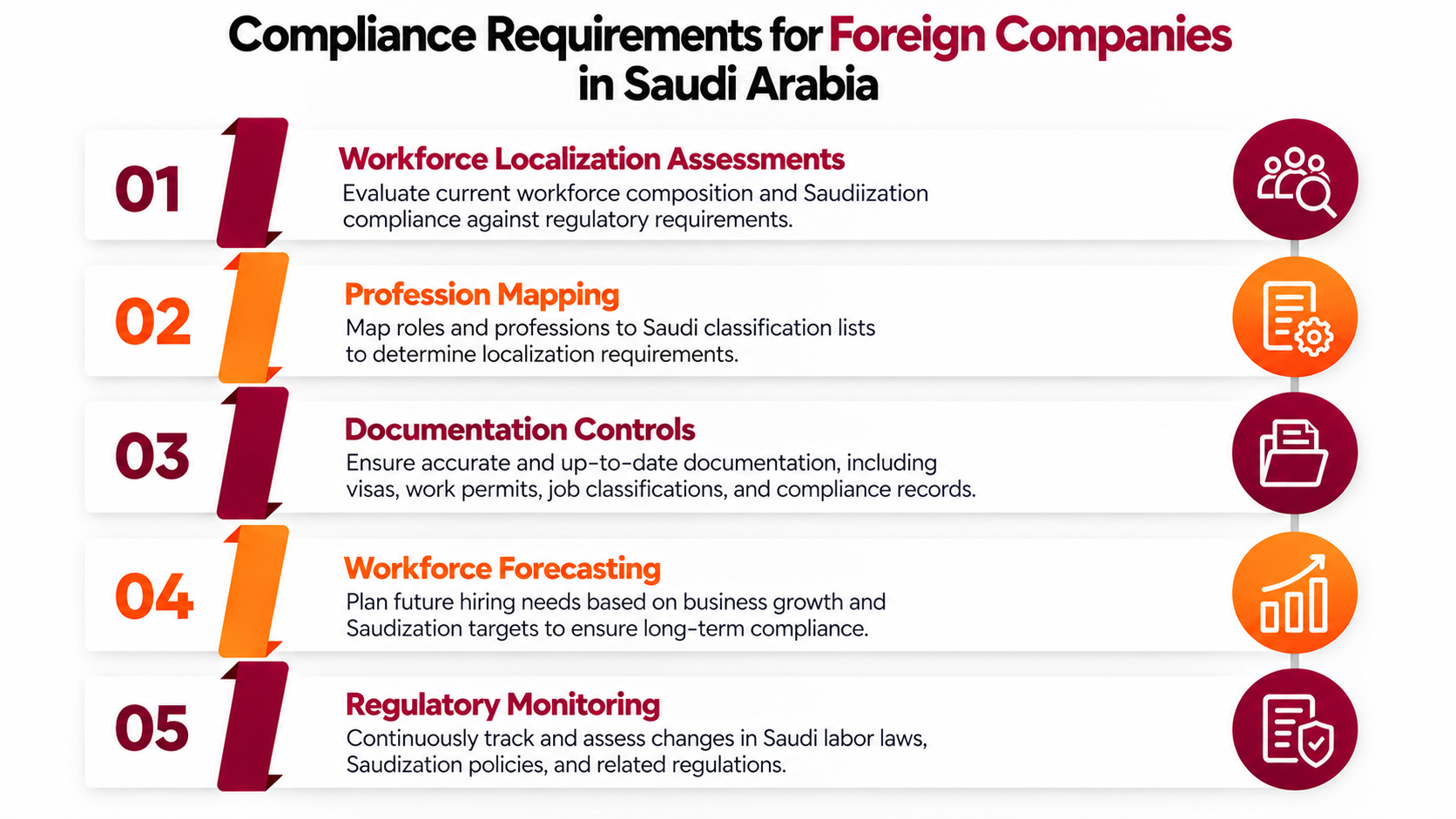
Foreign businesses entering the Saudi market should approach compliance planning with the same rigor applied to taxation, licensing, and legal structuring.
Several areas deserve particular attention.
Workforce Localization Assessments
Before expansion, organizations should evaluate expected Saudization obligations based on industry classification, workforce size, and planned operational activities.
Profession Mapping
Companies should identify roles subject to profession-specific localization requirements.
This process helps avoid workforce planning surprises after operations begin.
Documentation Controls
Employment contracts, labor records, compensation structures, and employee classifications should be maintained with exceptional accuracy.
Workforce Forecasting
Compliance planning should extend beyond current headcount requirements.
Future growth projections often influence localization strategies.
Regulatory Monitoring
Saudi labor regulations continue to evolve.
Organizations should establish mechanisms for tracking policy developments and assessing potential business impacts.
Companies that treat compliance as a continuous process generally experience fewer operational disruptions than those relying on periodic reviews.
Practical Hiring Strategies for Foreign Companies in Saudi Arabia
Developing effective hiring strategies for foreign companies in Saudi Arabia requires balancing business objectives with workforce localization requirements.
The most effective organizations typically focus on long-term capability building rather than short-term quota management.
Develop University Partnerships
Building relationships with educational institutions provides access to emerging talent pools and strengthens recruitment pipelines.
Create Graduate Development Programs
Structured programs help organizations identify high-potential candidates while supporting workforce localization objectives.
Invest in Employer Branding
Competition for skilled Saudi professionals continues to increase.
Strong employer brands attract better candidates and improve retention.
Prioritize Skills Development
Continuous training improves productivity while supporting career progression opportunities.
Reduce Reliance on Reactive Hiring
Organizations that plan workforce requirements years in advance generally achieve better compliance outcomes and stronger operational performance.
These strategies transform workforce localization from a compliance challenge into a competitive advantage.
How BVS Global Supports Organizations Navigating Workforce Localization Challenges
As Saudi Arabia continues strengthening workforce localization policies, businesses face increasing complexity across immigration, workforce planning, employee mobility, compliance management, and regulatory administration.
At BVS Global, we work closely with organizations expanding into highly regulated markets where labor compliance and mobility requirements are deeply interconnected. Our team supports businesses through immigration services, visa processing, document legalization, workforce mobility solutions, and regulatory guidance that helps simplify complex operational requirements.
Whether organizations are establishing a new presence in Saudi Arabia, expanding existing operations, relocating employees, or managing cross-border workforce movements, our expertise helps ensure that critical documentation, compliance obligations, and mobility processes are handled efficiently. By supporting employers throughout every stage of international expansion, we help businesses reduce administrative burdens while maintaining alignment with evolving workforce localization requirements.
Conclusion
Saudiization in 2026 represents a fundamental shift in how foreign companies must approach workforce planning within Saudi Arabia.
The conversation has moved far beyond workforce percentages and compliance reporting. Today’s regulatory environment places increasing emphasis on profession-specific localization, leadership development, workforce documentation, digital compliance systems, and sustainable employment creation.
Organizations that continue treating Saudiization as a short-term compliance exercise may find themselves facing growing operational constraints as workforce localization expectations expand.
Those that adopt a strategic approach will be positioned differently.
They will build stronger talent pipelines.
They will develop future leaders.
They will improve regulatory resilience.
They will gain greater workforce flexibility.
Most importantly, they will align themselves with the long-term direction of Saudi Arabia’s economic transformation.
For multinational corporations, foreign investors, regional headquarters, and international service providers, understanding Saudiization regulations, workforce localization obligations, compliance requirements, and hiring strategies for foreign companies in Saudi Arabia is no longer optional. It has become an essential component of sustainable growth in one of the world’s most ambitious and rapidly evolving business environments.
Frequently Asked Questions (FAQs)
1. What is Saudization (Nitaqat), and why is it important for foreign companies in Saudi Arabia?
Saudiization, also known as the Nitaqat Program, is Saudi Arabia’s workforce localization initiative designed to increase private-sector employment opportunities for Saudi nationals. For foreign companies, compliance with Saudiization regulations is critical because workforce localization levels can directly affect work permit approvals, visa issuance, labor mobility, and access to various government services. In 2026, Saudiization has become a strategic business consideration rather than simply an HR compliance requirement.
2. How have Saudization regulations changed in 2026?
The latest phase of the Nitaqat program places greater emphasis on profession-specific localization, digital compliance, and workforce quality rather than solely focusing on overall Saudization percentages. Several sectors now have targeted localization requirements for specific job categories such as marketing, sales, procurement, engineering, and finance. Companies must also ensure that employee records and contracts are properly documented through official labor platforms to maintain compliance.
3. What happens if a company fails to meet Saudization requirements?
Failure to meet Saudiization requirements can result in operational restrictions rather than just financial penalties. Companies may face challenges related to work permit issuance, visa processing, employee transfers, workforce expansion approvals, and access to certain government services. These restrictions can significantly impact business operations, especially for organizations that rely on expatriate talent or large-scale project deployments.
4. What are the best hiring strategies for foreign companies in Saudi Arabia?
Successful hiring strategies for foreign companies in Saudi Arabia focus on long-term workforce localization rather than short-term compliance. Effective approaches include building partnerships with universities, establishing graduate development programs, investing in employee training, developing Saudi leadership pipelines, and implementing structured succession planning. These initiatives help organizations meet compliance requirements while strengthening workforce capabilities.
5. How can businesses prepare for future workforce localization requirements in Saudi Arabia?
Companies should regularly conduct workforce localization audits, review profession-specific compliance obligations, assess expatriate dependency levels, and monitor regulatory updates. Developing a proactive workforce strategy that includes talent development, leadership training, and compliance monitoring can help organizations adapt to evolving Saudiization regulations while supporting sustainable business growth in the Kingdom.